
Bandwidth
Why Stage Fright Feels Like a Slow Internet Connection
Question:
“When you’re having coffee with a close friend, is it easy for you to express your thoughts?”
“Yes.”
“Can you look them in the eye?”
“Of course.”
“Can you think clearly? Tell a story? Remember things? Pause before answering? Smile naturally?”
Again, the answer is almost always yes.
So why does all of that seem to disappear the moment you step onto a stage?
The answer, I believe, is bandwidth.
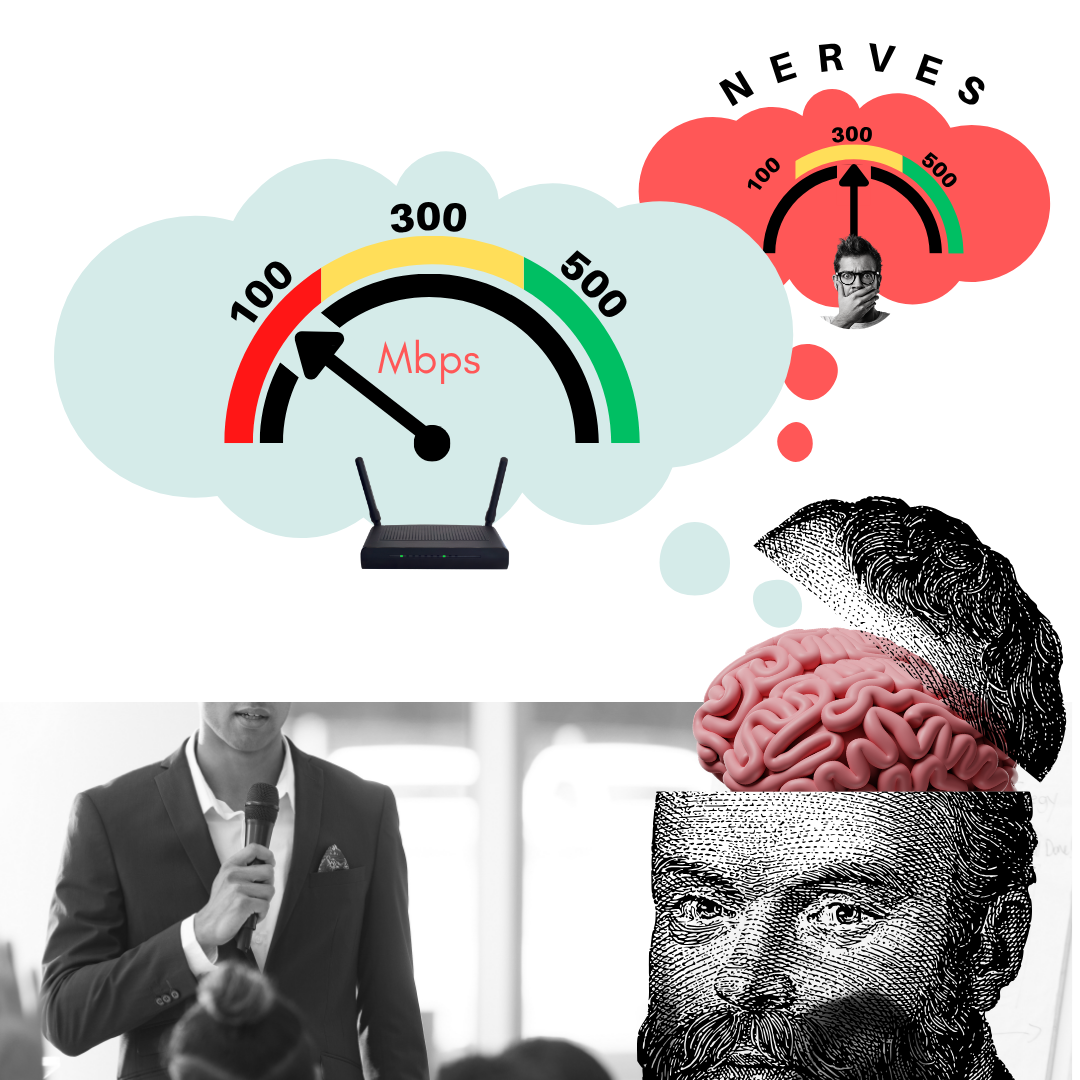
Imagine your brain is like an internet connection.
On a good day, you have all the bandwidth you need. You can think, listen, remember, improvise, smile, make eye contact, notice your audience, adjust your pace and even enjoy yourself.
Everything runs smoothly.
Now imagine that, just before your presentation, someone starts downloading a massive movie using your Wi-Fi.
Suddenly your connection slows to a crawl.
The internet still works—but barely.
Pages load slowly. Videos freeze. Everything takes more effort.
That’s what stage fright does.
Your abilities haven’t disappeared.
They’re simply competing for limited bandwidth.
Instead of focusing on your audience, a large part of your mental capacity is occupied by thoughts like:
“Don’t mess this up.”
“What if I forget?”
“Everyone is judging me.”
“What comes after this slide?”
Those thoughts consume precious cognitive resources.
What’s left has to cover everything else: remembering your next point, finding the right words, controlling your voice, making eye contact, reading the room, using gestures, standing confidently and staying aware of your timing.
It’s no wonder people speak too quickly.
It’s no wonder they forget what they wanted to say.
It’s no wonder they stop making eye contact.
These aren’t personality flaws.
They’re symptoms of running low on bandwidth.
Public speaking is one of the most demanding forms of multitasking we ever perform.
Imagine trying to juggle several balls at once.
One ball is your content.
Another is your voice.
Another is your body language.
Another is eye contact.
Another is timing.
Another is handling questions.
Presenting in a second language?
That’s another couple of balls.
Trying to impress your boss?
Add another.
The more balls you need to keep in the air, the more mental bandwidth you require.
Fortunately, there are two ways to solve the problem.
The first is to increase your available bandwidth by reducing the amount consumed by anxiety.
This is where experience makes such a difference.
The more often you speak, the less your brain interprets the situation as dangerous.
Little by little, the fear occupies less mental space.
Exposure, gradual challenges and good preparation all help your nervous system realise that standing in front of an audience is not a threat.
The second solution is to reduce the amount of bandwidth your presentation requires.
The better prepared you are, the less effort it takes to deliver.
If you know your material inside out, you’re no longer searching for your next sentence.
If you’ve rehearsed your opening twenty times, it almost runs automatically.
If you’ve simplified your slides, you have fewer things to think about.
If you’ve researched your topic thoroughly, you’re less worried about being challenged.
Preparation removes complexity.
Complexity demands bandwidth.
Excellent preparation frees bandwidth.
The best speakers don’t necessarily have more confidence than everyone else.
They’ve simply learned to attack the problem from both sides.
They reduce unnecessary stress through repeated exposure.
And they prepare so well that delivering the presentation no longer consumes all of their mental resources.
That’s when something remarkable happens.
You stop concentrating on yourself.
You start paying attention to the audience.
You notice their reactions.
You adapt.
You smile.
You pause.
You become spontaneous again.
In other words, you don’t become someone else on stage.
You finally recover enough bandwidth to become yourself.
Need help from a professional.
Contact Guy Benzeno | guy@centerstage.lu | Center Stage